
Affordable Housing Kenya: Complete 2026 Guide to Eligibility, Application & Investment
Affordable Housing Kenya is changing the conversation around homeownership, property development and urban living in 2026. With rising rental costs, increasing land prices and continued urbanization, owning a home can be difficult for many Kenyan households. The Government of Kenya’s Affordable Housing Programme seeks to address this challenge by increasing the supply of decent housing while creating structured pathways to homeownership.
For many Kenyans, buying a home has traditionally required a large deposit, significant savings or access to mortgage financing. This has placed homeownership beyond the reach of many low- and middle-income households. Affordable Housing Kenya aims to provide additional options through government-supported housing developments, structured payment arrangements and different housing categories.
The programme is therefore attracting interest from first-time buyers, salaried employees, civil servants, self-employed Kenyans, families and property investors.
But how does Affordable Housing Kenya work? Who qualifies? How do you register? What are the available housing categories? Where are projects located? And should you consider affordable housing as an investment opportunity?
This comprehensive 2026 guide explains what prospective homeowners and investors need to know before making a decision.
What Is Affordable Housing Kenya?
Affordable Housing Kenya refers to government-supported efforts to increase access to decent, accessible and reasonably priced housing for Kenyan citizens.
The Affordable Housing Programme is designed to serve different income groups and support the development of residential communities with supporting infrastructure and social amenities.
The Affordable Housing Board states that the programme targets the delivery of a minimum of 200,000 affordable housing units annually. It also states that Kenyan citizens aged 18 years and above with an identity card are eligible to apply for allocation of an affordable housing unit.
The programme is therefore more than simply constructing apartments. It is intended to create organized communities that can support long-term residential living.
Depending on the project, developments may include:
- Studio apartments
- One-bedroom apartments
- Two-bedroom apartments
- Three-bedroom apartments
- Social housing units
- Affordable housing units
- Market housing units
- Shops and commercial spaces
- Green spaces
- Children’s playgrounds
- Roads and pedestrian walkways
- Water infrastructure
- Electricity infrastructure
- Security facilities
- Community amenities
The exact features vary from one development to another.
For example, current projects listed on the official Boma Yangu platform include developments with amenities such as green spaces, playgrounds, secure boundaries, parking, water infrastructure and commercial facilities.
Why Affordable Housing Kenya Matters in 2026
Housing affordability has become an increasingly important issue as Kenya’s urban population grows.
Nairobi and its surrounding counties continue to attract people seeking employment, education and business opportunities. Other urban centres, including Mombasa, Nakuru, Machakos and emerging satellite towns, are also experiencing increased demand for residential property.
This creates pressure on existing housing supply.
When demand grows faster than supply, rental prices and property prices can increase. Consequently, households may spend a substantial portion of their income on accommodation without building an ownership stake in property.
Affordable Housing Kenya seeks to address this challenge by increasing housing supply and creating alternative routes to homeownership.
The potential benefits include:
- Increased access to homeownership
- More organized residential communities
- Reduced pressure on informal settlements
- Improved access to infrastructure
- Employment creation through construction
- Growth of supporting industries
- Increased household asset ownership
- Development of satellite towns
- Increased demand for property-related professional services
The wider economic impact is also important because housing development creates activity across construction, manufacturing, finance, transport, professional services and retail.
Affordable Housing Kenya Income Categories
One important consideration for prospective buyers is understanding the income category that applies to them.
The Affordable Housing Act, 2024 recognizes different housing categories based on income.
Social Housing
Social housing is intended for individuals earning below KES 20,000 per month.
This category addresses households facing the greatest affordability challenges.
Affordable Housing
The Act defines affordable housing as housing targeted at individuals earning between KES 20,000 and KES 149,999 per month.
This category covers a substantial portion of Kenya’s working population.
Affordable Middle-Class Housing
The legislation also recognizes affordable middle-class housing for individuals earning more than KES 149,999 per month.
This is important because Affordable Housing Kenya should not be interpreted as housing exclusively designed for low-income households.
Rural Affordable Housing
The programme framework also provides for rural affordable housing for people living outside urban areas.
This creates opportunities for housing development beyond major cities and can support economic growth in counties and rural communities.
Because housing categories and project terms can vary, applicants should always confirm the current requirements for their preferred development through official channels.
Who Qualifies for Affordable Housing Kenya?
Eligibility is one of the most frequently searched questions about Affordable Housing Kenya.
According to the Affordable Housing Board, Kenyan citizens who are over 18 years old and have an identity card are eligible to apply for allocation of an affordable housing unit.
This means the programme can be relevant to:
- First-time homebuyers
- Salaried employees
- Civil servants
- Private-sector employees
- Self-employed professionals
- Informal-sector workers
- Families
- Individual applicants
- Joint applicants
However, being eligible to register does not necessarily mean that an applicant will immediately receive a house.
Applicants still need to complete the registration process, provide the required information, save toward their housing deposit and meet the applicable requirements for their selected project.
This is an important distinction:
Registration is the starting point of the homeownership process, not a guarantee of immediate allocation.
Affordable Housing Kenya Locations
Projects under the programme are being developed in different parts of the country.
Current and listed projects demonstrate that Affordable Housing Kenya is extending beyond Nairobi into counties and emerging urban centres.
Examples include developments in:
- Nairobi
- Kiambu
- Machakos
- Makueni
- Kilifi
- Other urban and emerging locations
For example, the official Boma Yangu platform currently lists projects such as Shauri Moyo in Nairobi, Thika Uti in Kiambu, Konza City in Machakos and Mtwapa in Kilifi.
This geographical expansion is significant because housing demand is not concentrated in Nairobi alone.
Satellite towns and emerging urban centres can provide buyers with alternatives to expensive central locations.
However, affordability should not be the only consideration when selecting a location.
Potential buyers should assess:
- Road connectivity
- Public transport
- Distance to employment centres
- Schools
- Healthcare facilities
- Shopping centres
- Security
- Water availability
- Electricity
- Internet connectivity
- Future infrastructure
- Employment opportunities
- Population growth
A home with a lower purchase price may become expensive to live in if the owner has to spend significant amounts on daily transportation.
How to Apply for Affordable Housing Kenya
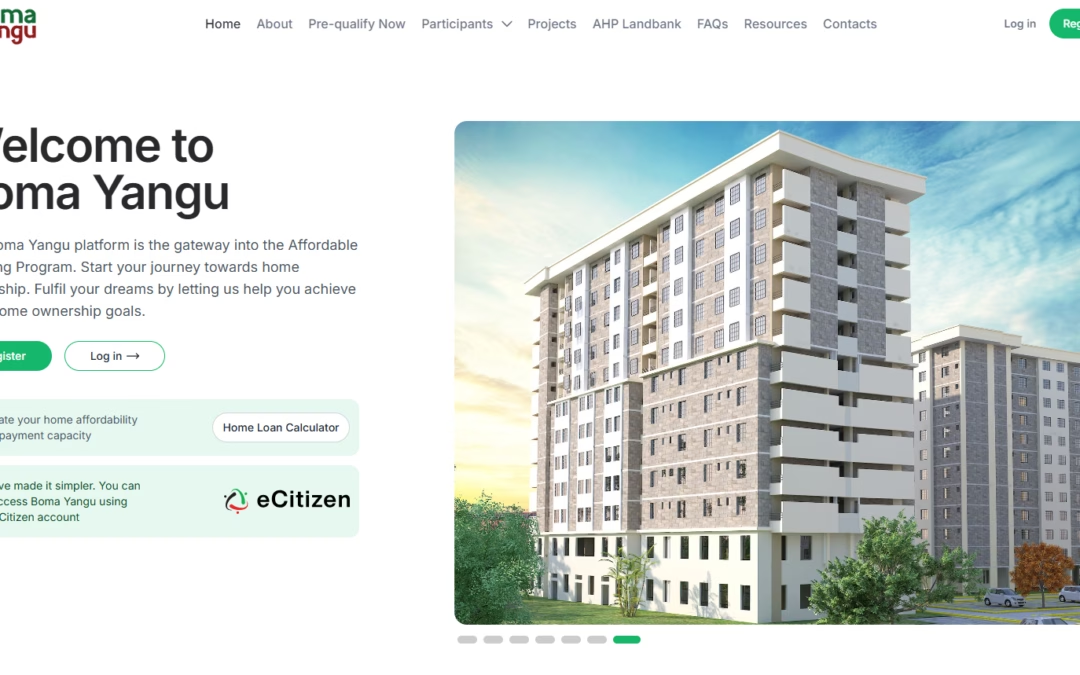
The application process begins through the official Boma Yangu platform.
The Affordable Housing Board states that registration is free and requires an eCitizen account. Applicants can register through the Boma Yangu web portal or by using the *832# USSD service.
Step 1: Create Your Account
Visit the official Boma Yangu housing portal and follow the registration process.
Applicants should ensure that their personal details match their identification documents.
Step 2: Complete Your Profile
Provide the required personal and financial information.
A complete and accurate profile is important because the allocation process depends on applicant information.
Step 3: Start Saving
The Affordable Housing Board states that an applicant can activate their account by saving a minimum of KES 200.
However, the amount required toward a particular home depends on the applicable housing unit and programme terms.
Step 4: Select Your Preferred Housing Option
Applicants can indicate their preferred location and housing type from available projects.
Options may include studios, one-bedroom, two-bedroom and three-bedroom units depending on the project.
Step 5: Meet the Applicable Requirements
Applicants may need to meet specific financial, eligibility and deposit requirements depending on their selected unit.
Step 6: Allocation
Qualified applicants proceed through the applicable allocation process for available units.
Step 7: Financing and Ownership
Once allocated, the applicant follows the applicable financing and ownership process.
Before signing any agreement, carefully review the payment schedule, ownership terms and other obligations.
How Much Should You Save for Affordable Housing Kenya?
Saving is a fundamental part of the homeownership process.
Applicants should avoid viewing Affordable Housing Kenya simply as a programme where registering automatically results in receiving a house.
Instead, it should be approached as a long-term financial commitment.
Your financial preparation should consider:
- Deposit requirements
- Monthly repayments
- Service charges
- Insurance
- Utilities
- Maintenance
- Moving expenses
- Transport costs
- Household expenses
The official Affordable Housing Board currently states that applicants can activate their Boma Yangu accounts by saving a minimum of KES 200.
However, the required deposit for a specific housing unit should be confirmed through the applicable project terms before making a financial commitment.
The most important question is not simply whether you can make the initial deposit.
It is whether you can comfortably meet the total monthly cost of homeownership over the long term.
Affordable Housing Kenya Financing Options
Financing is one of the most important aspects of the programme.
Depending on the specific project and applicant, financing may involve structured payment arrangements such as a Tenant Purchase Scheme or mortgage financing.
Tenant Purchase Scheme
A Tenant Purchase Scheme allows a buyer to make structured payments toward eventual ownership.
This approach can be attractive to households that may not have access to conventional mortgage financing.
Mortgage Financing
Some buyers may qualify for mortgage financing.
Before accepting a mortgage, compare:
- Interest rate
- Loan tenure
- Monthly repayment
- Processing fees
- Insurance costs
- Early repayment terms
- Total amount payable
A lower monthly payment does not necessarily mean a cheaper mortgage.
Cash Purchase
Where applicable, a buyer with sufficient funds may consider purchasing a property without long-term financing.
However, buyers should avoid using all their savings to purchase property without maintaining an emergency reserve.
Affordable Housing Kenya vs Renting
One of the biggest financial decisions facing Kenyan households is whether to continue renting or purchase a home.
Renting offers flexibility.
It can be appropriate for people who:
- Expect to relocate
- Are changing jobs
- Are building savings
- Are not ready for a long-term financial commitment
- Need temporary accommodation
Homeownership, on the other hand, can provide long-term security and asset ownership.
Consider a household paying KES 30,000 in rent every month.
Over five years:
KES 30,000 × 60 months = KES 1.8 million
This does not automatically mean buying a house is better than renting.
A buyer must consider interest, service charges, maintenance, transport, location and property value.
The better question is:
Which option creates the strongest financial position for your household over the next 5, 10 or 20 years?
Is Affordable Housing Kenya a Good Investment?
Affordable Housing Kenya can potentially create investment opportunities, but investors should avoid assuming that every affordable unit automatically makes a good investment.
A property investment should be assessed using measurable factors such as:
- Purchase price
- Location
- Rental demand
- Expected rental income
- Service charges
- Financing costs
- Vacancy risk
- Resale conditions
- Infrastructure
- Population growth
- Future development
The official Boma Yangu platform, for example, currently lists different unit categories and prices across projects. Some projects include affordable, social and market units within the same development.
This means investors need to compare the actual numbers rather than assuming that an affordable unit will automatically generate strong returns.
For investors considering a housing or development opportunity, GIMCO Limited provides Feasibility Study services designed to help investors and developers assess project viability, market demand, profitability and risk.
Can Affordable Housing Kenya Generate Rental Income?
Potentially, yes, depending on the applicable ownership agreement.
An investor should never assume that every affordable housing unit can be freely rented, transferred or resold.
Before purchasing for investment purposes, confirm:
- Whether the unit can be rented
- Whether subletting is permitted
- Whether resale is restricted
- Whether there is a minimum holding period
- Whether there are transfer conditions
- Whether service charges apply
- Who manages the development
These conditions can significantly affect investment returns.
If the unit is eventually rented out, professional property management can also become important.
GIMCO Limited provides Property Management services covering areas such as tenant management, property maintenance, financial management and investment optimization.
How to Calculate the Rental Yield
Investors should calculate potential returns before purchasing.
The basic formula is:
Gross Rental Yield = Annual Rental Income ÷ Property Purchase Price × 100
For example, if a property costs KES 4 million and generates KES 25,000 per month:
Annual rental income:
KES 25,000 × 12 = KES 300,000
Gross rental yield:
KES 300,000 ÷ KES 4,000,000 × 100 = 7.5%
However, 7.5% is a gross yield.
An investor must still consider:
- Service charges
- Repairs
- Property management fees
- Vacancy
- Insurance
- Taxes
- Financing costs
- Other operating expenses
The resulting net return provides a more realistic picture of investment performance.
Benefits of Affordable Housing Kenya
There are several potential benefits associated with the programme.
1. Greater Access to Homeownership
The programme creates another route toward property ownership for eligible Kenyan citizens.
2. Structured Payments
Depending on the project, buyers may access structured financing rather than requiring the entire purchase price upfront.
3. Planned Communities
Many projects incorporate infrastructure and shared amenities.
For example, the official Boma Yangu project listings show developments incorporating features such as green spaces, playgrounds, parking, security and water infrastructure.
4. Potential Long-Term Asset Ownership
Property ownership can contribute to household wealth when the property is appropriately financed and located.
5. Economic Development
Housing development creates employment and stimulates demand across several industries.
6. Growth of Satellite Towns
Affordable residential developments can support the expansion of emerging urban centres.
Challenges of Affordable Housing Kenya
Although the programme offers opportunities, prospective buyers should also understand its potential challenges.
High Demand
Demand for affordable homes can exceed available supply.
This means applicants may not always receive their preferred unit or location.
Financing Pressure
An affordable purchase price does not necessarily mean the monthly payment will be easy for every household.
Applicants should calculate their full housing cost before committing.
Location
Some developments may be further from major employment centres.
Transport costs should therefore form part of the affordability calculation.
Service Charges
Apartment owners may be required to contribute toward maintenance and management of shared facilities.
Allocation Timelines
The time between registration, qualification, allocation and occupation can depend on project-specific factors.
Applicants should therefore avoid making financial decisions based on assumptions about completion or occupation dates.
Affordable Housing Kenya Due Diligence Checklist
Before making a commitment, prospective homeowners and investors should conduct proper due diligence.
Verify the Project
Use official government platforms to confirm the project and its current status.
The Boma Yangu projects page provides information on listed housing developments.
Understand the Total Cost
Do not focus only on the advertised purchase price.
Ask about:
- Deposit
- Monthly payments
- Interest
- Service charges
- Insurance
- Legal costs
- Registration
- Maintenance
- Other applicable charges
Visit the Location
Where possible, physically inspect the development and surrounding neighbourhood.
Evaluate Accessibility
Assess roads, public transport and proximity to essential amenities.
Understand Ownership Terms
Confirm the rules regarding:
- Resale
- Transfer
- Renting
- Subletting
- Renovation
- Service charges
Assess Your Financial Position
Calculate whether the monthly commitment remains affordable after considering all your existing expenses.
For investors, professional property valuation services can provide independent information about property value and support informed decision-making.
Economic Impact of Affordable Housing Kenya
The programme has implications beyond individual homeowners.
Construction creates employment for:
- Architects
- Engineers
- Quantity surveyors
- Contractors
- Skilled tradespeople
- Suppliers
- Transport providers
- Property managers
- Financial institutions
Housing developments can also encourage the expansion of surrounding commercial areas.
When a new residential community attracts thousands of residents, demand increases for:
- Shops
- Schools
- Healthcare
- Restaurants
- Transport
- Professional services
- Entertainment
- Retail
Consequently, Affordable Housing Kenya can contribute to wider urban and economic development when supported by appropriate infrastructure.
Affordable Housing Kenya and the Property Market
The programme could also influence the wider Kenyan property market.
Developers may increasingly focus on high-volume housing rather than exclusively targeting the luxury segment.
Property professionals may also see increased demand for:
- Valuation
- Feasibility studies
- Property management
- Research consultancy
- Sales and letting
- Investment advisory
- Facilities management
This creates opportunities for real estate consultancies to support buyers, investors, developers and institutions navigating the changing market.
For example, GIMCO Limited’s Valuation Services provide professional property valuation across Kenya and East Africa, supporting clients who require reliable property information for investment and decision-making.
The Future of Affordable Housing Kenya
The future of Affordable Housing Kenya will depend heavily on the ability to deliver sufficient housing supply, accessible financing and supporting infrastructure.
The Affordable Housing Board states that the programme targets a minimum of 200,000 affordable housing units annually.
If successfully implemented at scale, this could have a substantial impact on Kenya’s residential property market.
Future developments could increasingly incorporate:
- Mixed-use communities
- Improved transport connectivity
- Green spaces
- Energy-efficient buildings
- Digital infrastructure
- Community facilities
- Commercial centres
- Better urban planning
For buyers, this means that the programme should be viewed as part of a wider transformation in Kenya’s housing market.
Frequently Asked Questions About Affordable Housing Kenya
What Is Affordable Housing Kenya?
It is a government-supported housing initiative designed to increase access to decent and affordable homes for eligible Kenyan citizens across different income categories.
Who Can Apply for Affordable Housing Kenya?
The Affordable Housing Board states that Kenyan citizens over 18 years old with an identity card are eligible to apply.
How Do I Register for Affordable Housing Kenya?
Registration can be completed through the official Boma Yangu portal or through the *832# USSD service. Registration is free, according to the Affordable Housing Board.
How Much Do I Need to Save?
The Affordable Housing Board currently states that a minimum saving of KES 200 is required to activate a Boma Yangu account. The required deposit toward a specific unit depends on the applicable project and housing arrangement.
Can Self-Employed Kenyans Apply?
Yes. The programme is not exclusively for salaried employees. Self-employed and informal-sector workers can participate, subject to the applicable requirements.
Can Civil Servants Apply?
Yes. Civil servants can participate in the programme if they meet the applicable requirements.
Can I Buy Affordable Housing as an Investment?
Potentially, but buyers should assess rental demand, financing costs, service charges, ownership restrictions, location and potential resale value before investing.
Can I Rent Out My Unit?
This depends on the applicable ownership agreement. Always confirm the current rental and subletting conditions for the specific project.
Where Can I Find Official Project Information?
Use official sources such as the Affordable Housing Board and Boma Yangu rather than relying on unverified social media advertisements or third-party agents.
Should You Apply for Affordable Housing Kenya in 2026?
For many Kenyans, the programme may provide an attractive opportunity to pursue homeownership.
It may be particularly suitable if you:
- Want to buy your first home
- Have a stable income
- Can consistently save
- Understand the required deposit
- Are comfortable with the location
- Can manage the monthly payments
- Plan to stay in the property for the long term
However, applicants should be cautious if they already have substantial debt or an unstable income.
The objective should not simply be to qualify for a house.
The objective should be to own a home without creating unsustainable financial pressure.
Final Thoughts on Affordable Housing Kenya
Affordable Housing Kenya represents a significant change in how homeownership and residential development are being approached in the country.
For many years, high property prices, large deposits and expensive mortgage financing have prevented many households from purchasing homes.
The Affordable Housing Programme provides another pathway by combining housing development with structured registration, saving and financing mechanisms.
Nevertheless, prospective homeowners should approach the programme carefully.
Before committing, research the project, understand the total cost, evaluate the location, confirm the ownership terms and assess whether the monthly payments fit comfortably within your budget.
For investors, the same principle applies.
Do not purchase simply because a unit is described as affordable. Assess rental demand, expected returns, financing costs, service charges, market growth and applicable restrictions.
If you need professional assistance evaluating a property or investment opportunity, GIMCO Limited can support you through services including property valuation, feasibility studies and property management.
Ultimately, a home is more than a place to live.
It can become a long-term financial asset, a source of security and an important part of building household wealth.
Get Professional Property Guidance
Are you considering Affordable Housing Kenya, purchasing your first home or evaluating a property investment?
GIMCO Limited provides professional real estate consultancy services to help clients make informed property decisions.
Our property specialists can assist with:
- Property valuation
- Feasibility studies
- Property investment analysis
- Property sales and letting
- Property management
- Market research
- Development advisory
- Real estate consultancy
You can learn more about our services through the GIMCO Limited website.
For direct assistance, contact GIMCO Limited and speak with our property specialists about your requirements.
Make your next property decision with accurate information, professional guidance and a clear understanding of the market.


