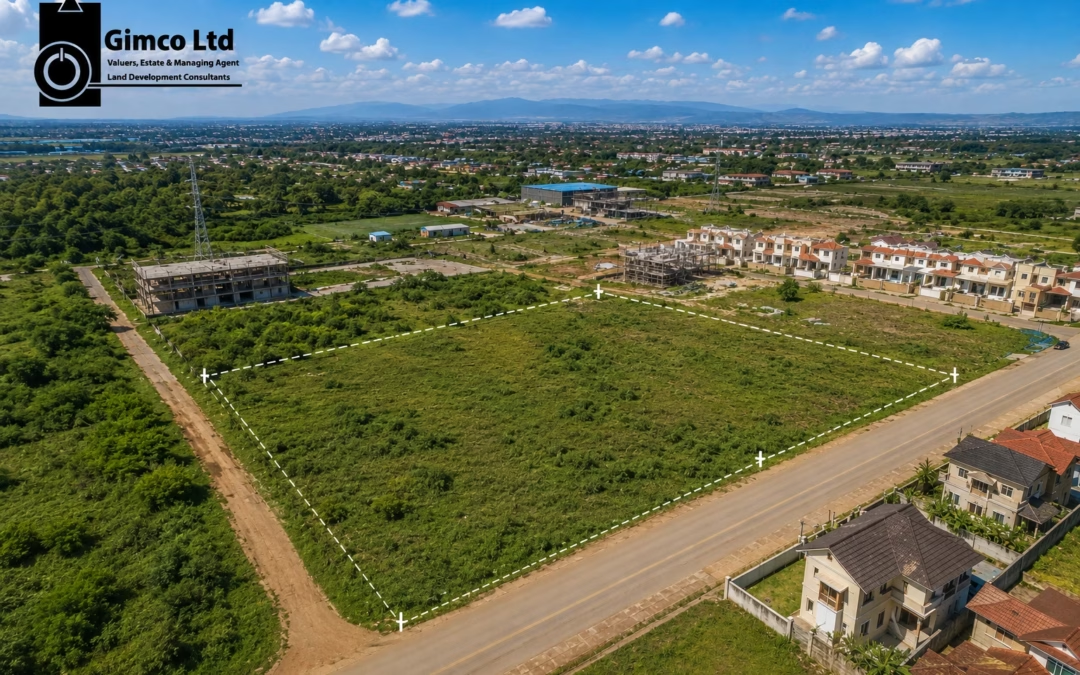
LET US Evaluate Land Development Potential in Kenya Before Buying
Land development potential in Kenya is an important consideration for anyone planning to buy property for residential, commercial or mixed-use development. Understanding the land development potential in Kenya before purchasing can help investors identify opportunities, anticipate development challenges and make better-informed property decisions.
Buying land in Kenya can be a valuable long-term investment, but not every parcel has the same development potential. A plot may appear affordable and strategically located, yet factors such as zoning, accessibility, infrastructure, surrounding developments, land use restrictions, and title documentation can significantly affect its future value.
Whether you are buying land for your own development, future resale or long-term investment, evaluating the property beyond its current appearance is essential.
What Does Land Development Potential Mean?
When assessing land development potential in Kenya, investors should look beyond the purchase price. The location, permitted land use, infrastructure, accessibility, physical characteristics, and surrounding developments can all determine whether a parcel is suitable for the intended project.
Land development potential refers to the ability of a parcel of land to support a particular type of development while remaining legally, physically, and financially viable.
For example, a vacant parcel may have potential for:
- Residential homes
- Apartments
- Townhouses
- Commercial buildings
- Offices
- Retail developments
- Warehouses
- Mixed-use developments
- Hospitality facilities
- Institutional developments
However, the fact that land is vacant does not automatically mean that any type of development can be constructed on it.
Several factors determine whether a property can accommodate the development you have in mind. Investors should therefore assess the land itself, the surrounding market and the applicable planning requirements before making a commitment.
1. Start With the Location
Location is one of the most important factors when assessing land development potential in Kenya.
A strategically located parcel can benefit from population growth, improved infrastructure, expanding commercial activity and increasing demand for housing or business premises.
When evaluating a location, consider:
- Proximity to major roads
- Access to public transport
- Distance from commercial centres
- Nearby schools and hospitals
- Existing residential developments
- Employment centres
- Shopping and entertainment facilities
- Planned infrastructure projects
- Security and neighbourhood quality
For example, land located close to established residential estates may have strong potential for housing development, while land near major commercial corridors may be more suitable for offices, retail or mixed-use developments.
Investors looking for opportunities can explore GIMCO’s current land for sale in Kenya to compare different locations, plot sizes and property opportunities.
Location should be assessed based on both current demand and future growth.
A strong location can significantly improve land development potential in Kenya because areas experiencing population growth, improved infrastructure and increasing property demand may offer greater opportunities for future development.
2. Check the Permitted Land Use
Before buying land, determine what the property can legally be used for.
Different areas have different planning and zoning requirements. A parcel may be designated for residential, commercial, agricultural, industrial or mixed-use development.
This is particularly important when purchasing land for investment.
Imagine purchasing a parcel intending to construct apartments only to discover that the permitted development does not support your intended project. Such restrictions can affect the property’s financial viability and may require additional approvals or changes to the proposed development.
Consult the relevant county planning authorities and obtain professional advice before committing to the purchase.
For official information about land administration and related government services, buyers can also refer to ArdhiSasa, the Kenyan government’s digital land information platform.
3. Investigate Accessibility and Road Connectivity
Good accessibility can significantly influence the land development potential in Kenya.
A property with reliable road access is generally more attractive to developers, residents, businesses and future buyers.
Check:
- Whether the property has a legally recognized access road
- The condition of the access road
- Road width
- Distance to the nearest tarmac road
- Accessibility during rainy seasons
- Availability of public transport
- Proposed road improvements
A parcel that is inexpensive but difficult to access may require significant infrastructure investment before development can begin.
When comparing two similar parcels, accessibility can therefore become an important factor in determining which investment offers better potential.
4. Assess Existing Infrastructure
Infrastructure can make the difference between a development that is immediately viable and one that requires substantial additional investment. Investors evaluating land development potential in Kenya should therefore determine whether essential infrastructure is already available or whether additional infrastructure investment will be required before development can begin.
Check the availability of:
- Electricity
- Water
- Sewerage
- Drainage
- Internet connectivity
- Roads
- Street lighting
- Waste management
Where mains sewerage is unavailable, a developer may need to consider alternative systems depending on the proposed development and applicable regulations.
Similarly, inadequate drainage can create challenges for construction and future property management.
The more infrastructure already available, the easier it may be to develop the property.
5. Study the Surrounding Developments
Look beyond the boundaries of the property. Studying surrounding developments is particularly useful when determining land development potential in Kenya, because neighbouring residential, commercial and infrastructure projects can provide indications of how the area is evolving.
The developments surrounding a parcel can provide valuable clues about its future potential.
Ask:
- What types of properties are being constructed nearby?
- Are residential estates expanding?
- Are commercial buildings increasing?
- Are new roads being constructed?
- Are schools, hospitals or shopping centres opening?
- Is the area attracting established developers?
For example, if an area that was previously dominated by vacant land is experiencing rapid construction of apartments and gated communities, this could indicate increasing demand for residential property.
However, investors should avoid assuming that every rapidly developing area will automatically produce strong returns. Demand, affordability, competition and infrastructure should also be examined.
6. Examine the Size and Shape of the Plot
The physical characteristics of the land can affect what can be developed. The size and configuration of a property can either increase or limit its land development potential in Kenya. Larger parcels may provide opportunities for subdivision or larger developments, while smaller or irregularly shaped plots may have more limited options.
Consider:
- Total acreage
- Plot dimensions
- Shape of the parcel
- Road frontage
- Building setbacks
- Easements
- Riparian areas
- Existing structures
- Natural features
A rectangular parcel with good road frontage may provide more practical development options than an irregularly shaped parcel of the same size.
For larger parcels, professional planning and feasibility analysis can help determine how the available space could potentially be used.
If you are considering a large-scale development, GIMCO’s feasibility study services can help assess the commercial and financial viability of a proposed project before significant capital is committed.
7. Assess the Terrain and Soil Conditions
Physical site conditions are another important component of land development potential in Kenya.
Steep slopes, rocky ground, poor drainage or unstable soil can increase construction costs.
Before purchasing land for a major development, consider obtaining appropriate professional assessments Ultimately, land development potential in Kenya depends not only on whether construction is physically possible, but also on whether there is sufficient market demand for the proposed development.
Depending on the project, this may include:
- Topographical surveys
- Geotechnical investigations
- Soil assessments
- Environmental assessments
- Drainage assessments
These investigations can reveal potential development challenges before substantial capital is committed.
A property that appears inexpensive may become significantly more expensive if extensive ground preparation or drainage works are required.
8. Verify the Title and Ownership
Development potential means little if ownership of the property cannot be properly established. A proper assessment of land development potential in Kenya should therefore include a realistic estimate of the total development cost and the potential revenue or value that the completed project could generate.
Before buying land, conduct the necessary due diligence to confirm:
- The registered owner
- Title details
- Parcel information
- Encumbrances
- Charges
- Restrictions
- Caveats
- Boundary information
Official land information services such as ArdhiSasa can support land-related processes where applicable.
Buyers should also work with qualified legal and property professionals when undertaking significant transactions.
Do not rely solely on documents provided by the seller.
Proper title verification can help protect buyers from ownership disputes and other legal complications.
9. Check for Easements and Restrictions
Some properties have restrictions that can affect development.
These may include:
- Road reserves
- Utility wayleaves
- Riparian restrictions
- Access easements
- Planning restrictions
- Environmental restrictions
- Existing leases or interests
Such issues may not be immediately visible when physically inspecting the property.
Professional due diligence can help identify restrictions that could affect the development plan.
Understanding these limitations early allows an investor to determine whether the property remains viable before proceeding with the transaction.
10. Consider the Demand for the Proposed Development
One of the biggest mistakes investors make is focusing on the land without researching the market.
The real question is not simply:
“Can I build here?”
It should be:
“What development does the market actually need here?”
Before buying, investigate:
- Who lives or works in the area?
- What property types are in demand?
- What are comparable property prices?
- What are prevailing rental rates?
- How much competition exists?
- What income levels can the target market support?
- How quickly are similar properties being absorbed?
For example, building luxury apartments in an area where demand is primarily for affordable housing may create a mismatch between the development and the market.
Market research should therefore form part of the investment decision.
GIMCO’s research consultancy services can also be relevant when investors require professional market analysis before undertaking a major property development.
11. Calculate the Development Costs
A parcel may look attractive based on its purchase price but become less attractive after development costs are considered.
Your analysis should account for:
- Land acquisition cost
- Legal fees
- Professional fees
- Planning approvals
- Architectural costs
- Construction costs
- Infrastructure costs
- Financing costs
- Marketing costs
- Taxes and statutory charges
- Contingency costs
The objective is to understand the total project cost, rather than evaluating the land price in isolation.
For example, a cheaper plot requiring major infrastructure upgrades may ultimately be more expensive than a higher-priced property that already has good road access, water, electricity and other essential services.
12. Carry Out a Feasibility Study
For larger or more complex developments, a professional feasibility study can help determine whether the proposed project makes financial and market sense.
A feasibility study may examine:
- Market demand
- Development options
- Construction costs
- Expected sales or rental income
- Development timeline
- Financing requirements
- Potential risks
- Expected returns
This is particularly valuable when purchasing land for apartments, commercial buildings, mixed-use developments or other capital-intensive projects.
A feasibility study can help answer an important question:
Is this the right property for the development I want to build?
Before purchasing a high-value development site, investors can consider engaging a professional consultancy such as GIMCO Limited to obtain property advice and feasibility support.
13. Look at Future Infrastructure and Urban Growth
Current infrastructure is important, but future infrastructure can also influence land development potential in Kenya.
Consider whether there are planned:
- Roads
- Transport links
- Schools
- Hospitals
- Commercial centres
- Industrial developments
- Residential estates
- Public infrastructure projects
Infrastructure improvements can increase accessibility and potentially stimulate property demand.
However, planned projects should be verified through credible sources rather than relying solely on claims from sellers or agents.
Where relevant, investors should consult official government and county sources for information on planning and infrastructure developments.
14. Compare the Property With Alternatives
Never evaluate a parcel in isolation.
Compare it with similar properties based on:
| Factor | Property A | Property B |
|---|---|---|
| Purchase price | ||
| Size | ||
| Accessibility | ||
| Infrastructure | ||
| Zoning | ||
| Surrounding development | ||
| Development costs | ||
| Market demand | ||
| Expected returns |
GIMCO’s property listings provide an opportunity to compare available properties based on location, size, property type and intended use.
This approach can reveal whether you are actually buying a good opportunity or simply an attractively marketed property.
15. Work With Qualified Property Professionals
Land development involves legal, financial, planning and technical considerations.
Depending on the transaction, professional support may include:
- Real estate consultants
- Valuers
- Surveyors
- Advocates
- Physical planners
- Architects
- Engineers
- Environmental professionals
- Quantity surveyors
A professional property consultant can help investors assess the location, market conditions and development opportunity before committing significant capital.
For investors who need an independent assessment of property value, GIMCO also provides property valuation services to support informed property decisions.
Final Thoughts
Evaluating land development potential in Kenya requires more than looking at the size of a plot or its asking price. Investors need to consider location, planning regulations, accessibility, infrastructure, physical characteristics, ownership, market demand, development costs and potential returns.
A successful assessment should consider location, planning regulations, accessibility, infrastructure, physical characteristics, ownership, market demand, development costs and potential returns.
For investors, the goal should be to identify land where the location, legal position, physical characteristics and market opportunity work together.
If you are searching for land for development, you can explore GIMCO’s available properties to identify opportunities across different locations in Kenya.
For more complex projects, professional feasibility studies and property consultancy can help investors evaluate whether a proposed development is commercially and financially viable.
If you are considering purchasing land for residential, commercial or mixed-use development, conduct proper due diligence before committing your capital. By carefully assessing these factors, investors can identify land with stronger land development potential in Kenya and reduce the risks associated with making major property investment decisions.
Looking for land with development potential? Contact GIMCO Limited for professional real estate consultancy and property investment guidance.
Frequently Asked Questions
What is land development potential?
Land development potential refers to the suitability of a parcel for a particular type of development based on factors such as zoning, location, infrastructure, accessibility, physical characteristics and market demand.
How do I know if land is suitable for development in Kenya?
Review the property’s planning status, title information, access, infrastructure, terrain, surrounding developments and market demand. For significant investments, professional feasibility and due diligence are recommended.
Why is zoning important when buying land?
Zoning and planning requirements determine the types and scale of development that may be permitted on a property. Buyers should confirm the applicable requirements before purchasing land.
Should I conduct a feasibility study before buying land?
For large or complex development projects, a feasibility study can help determine whether the proposed development is financially and commercially viable before significant capital is committed.
What professionals should I consult before buying development land?
Depending on the project, you may need assistance from a property consultant, advocate, registered valuer, surveyor, physical planner, architect, engineer or other relevant professional.
About GIMCO Limited
GIMCO Limited is a real estate consultancy providing professional property services including property sales and letting, valuation, feasibility studies, research consultancy and property management.
Whether you are looking to buy land in Kenya, assess a development opportunity or understand the potential of an investment property, professional advice can help you make better-informed decisions.


