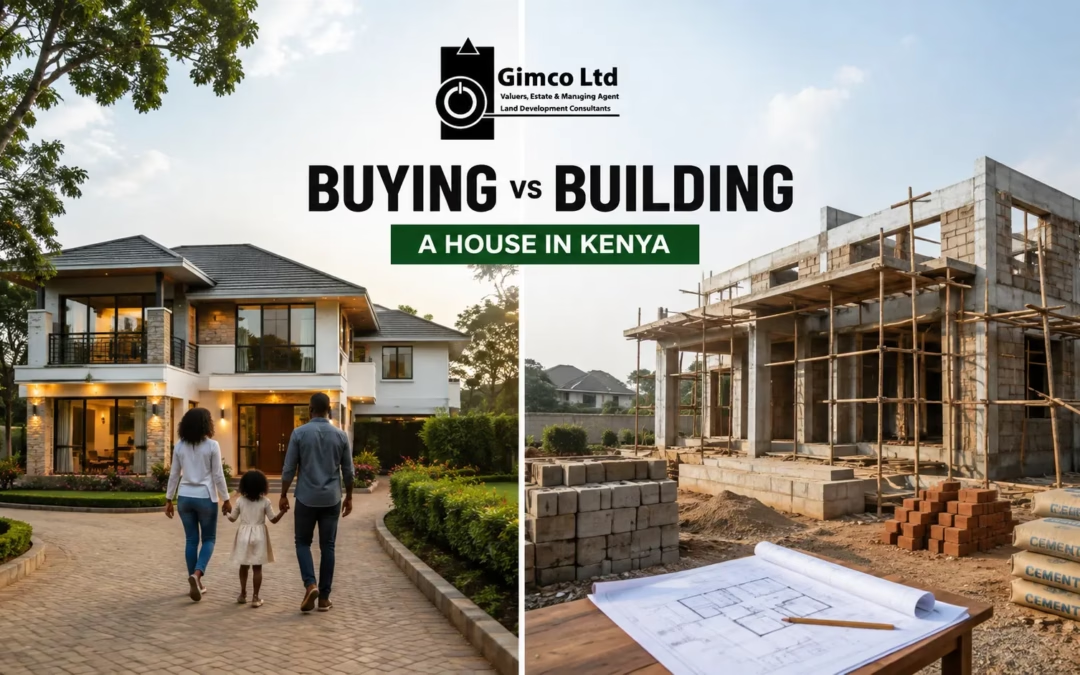
When it comes to homeownership, one of the biggest decisions you may face is buying vs building a house in Kenya. Should you purchase a completed home and move in, or buy land and construct a house according to your own design?
There is no single answer that works for every Kenyan buyer.
For some people, buying a completed house offers convenience, speed and greater cost certainty. For others, building a house provides the freedom to choose the design, materials, finishes and layout while potentially creating a home that better matches their long-term needs.
However, the decision should not be based only on the advertised purchase price or an estimated construction cost. You need to consider the total cost of ownership, available capital, financing, construction timeline, land ownership, professional fees, approvals, maintenance, location, resale potential and your personal ability to manage the project.
This guide provides a detailed comparison of buying vs building a house in Kenya to help you determine which option makes better financial and practical sense for your circumstances.
Buying vs Building a House in Kenya: What Is the Difference?
At a basic level, buying means purchasing a completed residential property from an existing owner or developer. Building means acquiring land and developing a home on that land, usually with the support of architects, engineers, quantity surveyors, contractors and other professionals.
The two options therefore involve very different processes.
When you buy a completed house, much of the development work has already been completed. You can inspect the property, assess its location and condition, establish its price and proceed with the purchase subject to satisfactory due diligence and financing.
When you build, you are effectively managing a development project. This means making decisions about land, design, approvals, construction, materials, contractors, budgets, timelines and quality control.
That distinction is important because the cheaper option on paper is not necessarily the cheaper option in reality.
A person who already owns serviced residential land and has access to construction financing may find building attractive. Another buyer who needs a home within three months may find that buying is significantly more practical, even if the purchase price appears higher.
1. Buying a House in Kenya: The Main Advantages
Buying a completed home is attractive because it reduces the number of decisions and processes you have to manage.
Immediate or Faster Occupation
One of the biggest advantages of buying a house is speed.
If the property is completed, vacant and legally ready for transfer, you can potentially move in much faster than someone starting a construction project from the ground up.
This can be particularly valuable if you are:
- Relocating for work
- Starting or expanding a family
- Moving from rented accommodation
- Returning to Kenya from abroad
- Looking for an investment property
- Working with a fixed relocation deadline
Construction can take months or longer depending on the size of the house, availability of funds, weather, approvals, contractor performance and changes to the design.
Buying therefore provides a level of convenience that building cannot easily match.
If you are currently looking for completed residential properties, you can explore GIMCO’s available properties and compare different houses, apartments and other property types.
Greater Cost Certainty
Another major advantage of buying is that you generally know the asking price before committing to the transaction.
This does not mean there are no additional costs. Buyers should still budget for legal fees, valuation, due diligence, financing costs, taxes or statutory charges where applicable, moving expenses and possible renovations.
However, the overall development risk is usually lower because you are not responsible for purchasing every bag of cement, negotiating every contractor invoice or absorbing every construction delay.
Building, by comparison, can expose you to changing material prices, labour costs, design changes and unforeseen site conditions.
Less Project Management
Buying a completed home removes much of the construction management burden.
You do not have to:
- Hire a contractor
- Monitor construction stages
- Approve every material purchase
- Coordinate architects and engineers
- Manage construction workers
- Arrange site meetings
- Monitor project timelines
- Deal with construction waste
- Handle day-to-day site supervision
For a busy professional or business owner, this can be a major advantage.
Your time also has an economic value. If managing a construction project takes several hours every week for a year, the opportunity cost can be significant.
You Can Inspect the Actual Property
When buying a completed property, you can physically see what you are purchasing.
You can assess:
- Room sizes
- Natural lighting
- Ventilation
- Finishes
- Plumbing
- Electrical installations
- Access roads
- Neighbouring developments
- Security
- Noise levels
- Drainage
- Parking
- General workmanship
This reduces some uncertainty because you are evaluating an existing asset rather than relying entirely on architectural drawings and projections.
However, buyers should still conduct professional due diligence and property inspection before completing the transaction.
Potentially Easier Financing
Financing structures vary between lenders, but completed properties can be easier for buyers to evaluate because the asset already exists and can be professionally valued.
The Central Bank of Kenya has historically identified factors such as interest rates, income levels, credit risk and property registration among issues affecting mortgage finance in Kenya.
If you intend to use mortgage financing, speak with your preferred lender early and establish:
- Your maximum borrowing capacity
- Required deposit
- Interest rate
- Loan term
- Monthly repayment
- Insurance requirements
- Valuation requirements
- Legal costs
- Other transaction charges
Do not choose a house simply because the monthly mortgage payment appears affordable. Your full housing cost should include maintenance, service charges where applicable, insurance, utilities and other recurring expenses.
2. The Disadvantages of Buying a House
Buying is convenient, but it also involves compromises.
Limited Customization
The biggest disadvantage is that you inherit someone else’s design decisions.
You may not like:
- The kitchen layout
- Bedroom sizes
- Number of bathrooms
- Finishes
- Lighting
- Garden design
- Parking arrangement
- Storage space
- Staircase configuration
- Floor plan
Renovations can solve some of these problems, but major structural changes can be expensive.
If you have a very specific vision for your ideal home, building may give you considerably more control.
Higher Purchase Price Does Not Always Mean Poor Value
A common mistake is to assume that buying is always more expensive than building.
That conclusion is too simplistic.
The purchase price of a completed house may include the cost of:
- Land
- Construction
- Professional fees
- Infrastructure
- Financing
- Landscaping
- Security
- Amenities
- Developer overheads
- Marketing
- Profit margin
- Taxes and statutory costs where applicable
However, a completed property may also be located in an area where land values have already appreciated significantly.
Therefore, the correct question is not:
“Is buying more expensive than building?”
Instead ask:
“What will I receive for every shilling I invest?”
A completed house in an established neighbourhood may provide better overall value than building a cheaper house on inexpensive land far from your preferred amenities, workplace or transport links.
Risk of Hidden Defects
A beautiful house can still have problems that are not obvious during a casual viewing.
Potential issues include:
- Water leakage
- Poor drainage
- Cracks
- Faulty electrical work
- Plumbing problems
- Dampness
- Poor-quality finishes
- Roofing problems
- Structural concerns
- Inadequate waterproofing
For this reason, buyers should consider professional inspection and legal due diligence before committing.
A property inspection can cost money, but discovering a serious defect before purchase can save you substantially more.
For professional property guidance, you can also explore GIMCO’s property services.
3. Building a House in Kenya: The Main Advantages
Building a house gives you greater control over the development process.
Full Design Flexibility
This is arguably the biggest reason people choose to build.
You can determine:
- Number of bedrooms
- Bedroom sizes
- Kitchen design
- Living room layout
- Ensuite bathrooms
- Home office
- Pantry
- Walk-in closets
- Garage
- Outdoor entertainment area
- Servant’s quarter
- Laundry area
- Storage
- Solar installation
- Water harvesting
- Future expansion
Instead of adapting your lifestyle to an existing house, you design the house around your lifestyle.
For a family planning to live in the property for decades, this can be extremely valuable.
Greater Control Over Materials and Finishes
Building also gives you more control over quality.
You can select flooring, doors, windows, sanitary fittings, roofing materials, cabinetry, lighting and other finishes according to your budget.
However, control does not automatically mean quality.
Poor project management can still result in inferior workmanship, even when expensive materials are purchased.
That is why professional supervision is important.
Potential to Build in Phases
If you already own land, you may be able to construct according to your financial capacity, subject to the design, financing arrangement and project requirements.
For example, a homeowner might prioritize:
- Land acquisition
- Professional design
- Approvals
- Foundation
- Structural works
- Roofing
- Plumbing and electrical installations
- Finishes
- Landscaping
This can make the financial burden more manageable than purchasing a completed property in one transaction.
However, phased construction has a major risk: delays.
A house that remains incomplete for years can become more expensive because materials, labour and design preferences may change.
Opportunity to Include Modern Features
Building from scratch allows you to incorporate features that may be difficult or expensive to retrofit later.
These could include:
- Solar power
- Rainwater harvesting
- Energy-efficient lighting
- Smart-home infrastructure
- Home office space
- Improved insulation
- Security systems
- Electric vehicle charging infrastructure
- Larger windows for natural lighting
- Modern ventilation systems
This can improve both the property’s functionality and its long-term appeal.
4. The Disadvantages of Building a House
Building provides control, but control comes with responsibility.
Construction Can Take Longer Than Expected
A construction schedule is not always a straight line.
Delays can result from:
- Funding shortages
- Material shortages
- Contractor delays
- Weather
- Approval processes
- Design changes
- Labour availability
- Poor project management
- Site conditions
A project initially expected to take eight months can take considerably longer if problems are not identified early.
If you are paying rent while simultaneously funding construction, every additional month can increase your effective housing cost.
Construction Costs Can Escalate
This is one of the biggest risks when comparing buying vs building a house in Kenya.
An initial construction estimate is not necessarily the final project cost.
Costs may increase because of:
- Changes in design
- Material price changes
- Additional labour
- Transport
- Site preparation
- Poor soil conditions
- Drainage requirements
- Boundary walls
- Landscaping
- Utility connections
- Security
- Professional fees
- Approval requirements
- Unplanned upgrades
A responsible construction budget should therefore include a contingency rather than assuming every cost will match the initial estimate.
You Need the Right Professionals
Building should not be treated as simply hiring fundis and purchasing materials.
A professional team may include:
- Architect
- Quantity surveyor
- Structural engineer
- Mechanical/electrical professionals where required
- Land surveyor
- Contractor
- Project manager
- Lawyer
The National Construction Authority states that construction projects require registration and lists requirements including approved architectural and structural drawings, relevant county approvals, qualified consultants and an NCA-registered contractor.
You can also review the National Construction Authority’s project registration requirements before commencing construction.
Approvals and Compliance Matter
Building without the appropriate approvals can expose a property owner to serious problems.
Depending on the location and nature of the development, approvals and regulatory requirements may involve county authorities and other agencies.
Nairobi City County’s built-environment functions include building approvals and urban planning, while its official resources include development approval information and current planning policies.
Before starting construction, confirm the applicable requirements for your specific site.
You can review Nairobi City County’s development approval requirements and consult the relevant county authority if your property is outside Nairobi.
5. Buying vs Building a House in Kenya: Cost Comparison
The financial comparison should go beyond the purchase price or construction estimate.
Costs When Buying
A buyer should consider:
- Purchase price
- Deposit
- Legal fees
- Valuation
- Due diligence
- Applicable taxes and statutory charges
- Mortgage arrangement costs
- Insurance
- Renovation
- Moving expenses
- Service charges where applicable
- Immediate maintenance
Costs When Building
A person building should consider:
- Land purchase
- Legal fees
- Land search and due diligence
- Surveying
- Site preparation
- Architectural fees
- Engineering fees
- Quantity surveying
- County approvals
- NCA requirements
- Contractor costs
- Building materials
- Labour
- Utilities
- Security
- Boundary wall
- Landscaping
- Professional supervision
- Financing costs
- Contingency
This is why comparing a KSh X million house with a KSh X million construction budget can be misleading.
The construction budget may not include land, professional fees, infrastructure or external works.
If You Already Own Land
The equation changes significantly if you already own suitable residential land.
In that situation, building may become more attractive because one of the largest components of the total development cost has already been addressed.
But the land still has an opportunity cost.
If you could sell the land today for KSh 5 million, that KSh 5 million represents economic value even though you do not physically pay it again during construction.
This is an important point that many prospective homeowners overlook.
6. Location Can Matter More Than the House
When deciding between buying and building, do not focus exclusively on the building.
Location is an investment decision.
Consider:
- Accessibility
- Road infrastructure
- Public transport
- Schools
- Hospitals
- Shopping centres
- Employment centres
- Security
- Utilities
- Drainage
- Future infrastructure
- Neighbourhood development
- Land-use regulations
- Rental demand
A beautifully constructed house in an inconvenient location may be less attractive than a modest house in a highly desirable neighbourhood.
If you choose to build, therefore, the land acquisition decision should receive as much attention as the architectural design.
GIMCO currently lists residential land in areas such as Kikuyu, Joska, Kitengela and other locations, illustrating how different land markets can offer very different entry points and development opportunities.
7. Think About Resale and Investment Value
Your home can be both a lifestyle asset and an investment.
Before buying or building, consider the property’s likely future marketability.
Ask:
- Would another buyer want this property?
- Is the location likely to remain desirable?
- Is the house functional for a typical family?
- Are the rooms appropriately sized?
- Is parking adequate?
- Is the title documentation in order?
- Are the improvements compliant?
- Can the property generate rental income?
- Is there potential for future redevelopment?
Avoid over-customizing a property purely around personal preferences if resale value matters to you.
A highly personalized home may be perfect for you but less attractive to the broader market.
8. Buying vs Building a House in Kenya: Which Is Better for You?
The answer depends on your circumstances.
Buy a House If:
Buying may be the better choice if:
- You need to move in quickly.
- You have sufficient funds for the purchase.
- You prefer predictable costs.
- You do not want to manage construction.
- You are comfortable with an existing design.
- You want to inspect the finished property before buying.
- You prefer an established neighbourhood.
- You are considering mortgage financing.
- You want to start generating rental income quickly.
Build a House If:
Building may be better if:
- You already own suitable land.
- You have a clear long-term vision.
- You want a customized home.
- You have the ability to manage a construction project.
- You have access to reliable professionals.
- You can tolerate construction delays.
- You have adequate funding and contingency reserves.
- You want to incorporate specific modern features.
- You plan to stay in the home for many years.
9. A Better Way to Make the Decision
Instead of asking simply, “Is buying or building cheaper?”, use a five-part decision framework.
Step 1: Establish Your Total Budget
Determine how much you can realistically invest without putting excessive pressure on your finances.
Do not use your maximum borrowing capacity as your target budget.
Step 2: Determine Your Timeline
If you need a home within six months, building may be difficult unless the project is already significantly advanced.
If you have several years and are comfortable with a phased project, construction may be more realistic.
Step 3: Compare Equivalent Properties
Do not compare:
KSh 10 million construction budget vs KSh 15 million house.
Instead compare equivalent assets:
Land + construction + professional fees + approvals + external works + financing + contingency
against:
Purchase price + transaction costs + renovations + financing + maintenance.
This gives you a much more realistic comparison.
Step 4: Evaluate Your Management Capacity
Ask yourself honestly:
Do I have the time, knowledge and professionals required to manage construction?
If the answer is no, building may still be possible, but you should budget for professional project management.
Step 5: Think Long Term
Consider where you expect to be in five, ten or twenty years.
Your ideal choice today may not be the best choice for your future.
A growing family may need more bedrooms. A professional may eventually need a home office. An investor may prioritize rental income and resale value.
10. A Simple Buying vs Building Decision Matrix
| Factor | Buying a House | Building a House |
|---|---|---|
| Speed | Faster | Slower |
| Customization | Limited | High |
| Cost certainty | Generally higher | Lower |
| Construction management | Minimal | Significant |
| Design control | Limited | Extensive |
| Professional involvement | Moderate | High |
| Risk of construction delays | Low | Higher |
| Ability to choose materials | Limited | High |
| Suitable for existing landowners | Depends | Often attractive |
| Suitable for urgent housing needs | Excellent | Less suitable |
| Potential for personalization | Moderate | Excellent |
| Investment assessment | Easier using existing asset | Requires development analysis |
11. Common Mistakes to Avoid
Whether you buy or build, avoid making a decision based purely on emotion.
Mistake 1: Looking Only at the Asking Price
A KSh 20 million house is not necessarily expensive if comparable properties in the same location are worth significantly more.
Likewise, a KSh 10 million construction budget does not mean the finished home will cost KSh 10 million.
Mistake 2: Ignoring Due Diligence
Never rush into a property transaction because you are afraid someone else will buy the property first.
Verify ownership, documentation, restrictions, approvals and other relevant matters through the appropriate professionals.
Mistake 3: Underestimating Construction Management
Building a house is a project, not merely a purchase of materials.
Weak supervision can result in delays, wastage and poor workmanship.
Mistake 4: Choosing Cheap Professionals
Professional fees should be evaluated based on value and competence, not simply price.
A cheap design that creates expensive construction problems is not actually cheap.
Mistake 5: Forgetting the Future
Think about maintenance, resale, expansion and changing family needs.
A house should work not only on the day you complete it but also years later.
12. Final Verdict: Should You Buy or Build?
There is no universal winner in the buying vs building a house in Kenya debate.
Buying is usually stronger for convenience, speed and cost predictability.
Building is usually stronger for customization, design control and flexibility.
The best choice depends on your financial position, whether you already own land, your preferred location, your timeline and how actively you want to participate in the development process.
If you already own strategically located land, have adequate funding and want a customized long-term home, building can be highly attractive.
If you want to move quickly, prefer convenience and want to see the finished product before committing, buying may be the smarter option.
The most important principle is this:
Do not choose between buying and building based on price alone. Choose based on total cost, time, risk, quality, location and long-term value.
Before committing to either option, seek professional property, legal and financial advice. A property decision of this size deserves more than an online calculator or a conversation with a contractor.
Make a Smarter Property Decision with GIMCO
Whether you are looking to buy a house, acquire land, evaluate an investment opportunity or understand the potential of a property, professional advice can help you make a more informed decision.
GIMCO Limited provides real estate consultancy services including property sales and lettings, valuation, property management, feasibility studies and development-related advisory services. The company states that it has more than 40 years of experience in real estate consultancy and operates across several Kenyan markets.
You can explore properties currently available for sale or contact GIMCO’s property experts to discuss your property requirements.
Whether you ultimately decide to buy or build, the goal should be the same: to acquire a property that makes financial sense, meets your lifestyle needs and creates sustainable long-term value.
Frequently Asked Questions About Buying vs Building a House in Kenya
Is it cheaper to build or buy a house in Kenya?
There is no universal answer. Building may be more cost-effective when you already own land and manage the project efficiently. However, you must include professional fees, approvals, labour, materials, infrastructure, external works and contingency. Buying may provide greater cost certainty and can be more attractive when the property is in a high-value established location.
Is building a house in Kenya a good investment?
It can be, particularly when the land is well located, the design meets market demand and construction is professionally managed. The investment case should be evaluated using the total development cost, expected property value, rental potential and future marketability.
What should I check before buying a house in Kenya?
Consider title and ownership documentation, property condition, location, planning considerations, access, utilities, approvals, valuation, potential encumbrances, neighbourhood characteristics and the property’s long-term investment potential. Professional legal and property due diligence is strongly recommended.
Do I need professionals when building a house?
Yes. The appropriate professional team depends on the project, but architectural, engineering, quantity surveying, surveying and construction expertise may be required. The NCA also specifies requirements relating to registered contractors, consultants, drawings and approvals for project registration.
Can I build a house in phases?
In some circumstances, yes. However, phased construction should be based on a coherent master plan and realistic funding strategy. Starting without a complete design and budget can result in inefficient work and increased costs later.
What is the biggest advantage of buying a house?
The biggest advantage is usually convenience and speed. You can evaluate an existing property and, subject to successful due diligence, financing and transfer, take occupation much sooner than with a new construction project.
What is the biggest advantage of building a house?
The biggest advantage is control. You can determine the design, room configuration, materials, finishes and features according to your needs and budget.
Should I buy land before deciding to build?
If building is your preferred strategy, suitable land should be assessed carefully before purchase. Location, title, zoning or planning considerations, access, utilities, soil and drainage conditions and development potential can significantly affect the eventual cost and value of the project.
Conclusion
The question of buying vs building a house in Kenya is ultimately a question of priorities.
If your priority is speed, convenience and greater cost certainty, buying a completed property may be the better route.
If your priority is customization, control and creating a home specifically around your needs, building may be more suitable.
Neither strategy is automatically superior.
The smartest approach is to compare both options using the same criteria: total cost, location, financing, timeline, quality, risk, lifestyle and future value.
A well-researched property decision can protect your capital, reduce unnecessary costs and help you build or acquire an asset that continues to serve you for years to come.


